
 Bookvault
 Photobubble
 BookWIZARD
South Africa Perspectives: Opportunities for Publishers in the Rainbow Nation

For publishers eager to grow their export sales, South Africa (dubbed the Rainbow Nation by the late Archbishop Desmond Tutu) is an intriguing possibility. A nation of 65m people living in a country 86% of the size of western Europe, it has a relatively young population (average age 28.9 years) of whom about half of these are proficient in English (only around 5 million have English as their first language). Though that suggests the core English language market is only the size of New Zealand, because English is the dominant language of government, business and academia in the country, it ensures a solid level of demand for English language titles. Figures from the Publishers Association of South Africa (PASA) showed that in 2024/25, 77% of publishing revenue by language was in English. Though South Africa is a long way away (Cape Town being around 6,000 miles from London, similar to San Diego, Buenos Aires, Tokyo and Manila), as the majority of English language books sold through trade channels in South Africa are imported, there are strong supply lines into the country ensuring that there are a number of ways an overseas publisher can engage with this fascinating market.
Market Entry Operational Challenges
The South African market is not without its challenges and that quickly becomes visible when you look at trade publishing. Nielsen Bookscan has been measuring trade sales in South Africa since 2010 and since then, has been gradually recording growing revenues that by 2024 had reached roughly R1.8bn (£81m).
Images reproduced from: https://nielseniq.com/global/en/insights/commentary/2025/sa-book-awards-celebrating-25-years-of-south-african-literature/
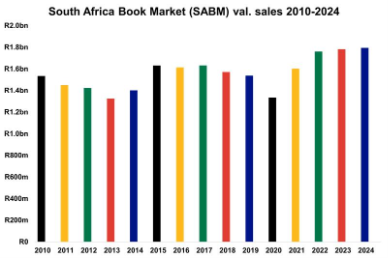
However, if you look at underlying sales volume over the same period, that has been falling year on year.
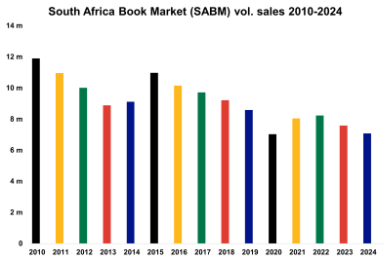
The reasons for declining sales may be in part the rising average price of a book, given most books are imported, coming up against stagnant purchasing power, but may also be indicative of changing customer habits such as the rise of genre fiction and children’s/YA at the expense of general adult fiction/non-fiction (the old dominant areas of trade demand).
One positive is that the average price of a South African book expressed in Sterling, at around £11.40, is nothing like as low as in a market like India and in many ways a reflection of the fact that the dominant format for trade sales in South Africa is the paperback. In other words, you don’t need the steep discounts required for some emerging markets to be able to make successful sales in South Africa.
Even so, one thing to be mindful of when looking at pricing is South African VAT which now stands at 15%. Books are not exempt from VAT, unlike in many markets, and there are no exemptions (including no de minimis level) for book importation. Moreover, for imports from key regions like Europe and North America, 15% VAT is based on a calculated Added Tax Value that aims to include freight and insurance costs, not the underlying cost of the book alone. So on top of the long supply chain to get books into South Africa, there’s an awkward cost hump at the end of that journey to be negotiated.
However, trade figures only reflect a part of the market. Figures from PASA, indeed, show that most book sales are concentrated in other areas, particularly education that in 2023/24 constituted almost 60% of domestic publishing revenues. This market is heavily dependent on government spending and recent issues around textbook procurement have had high profile adverse impacts on both publishers and their suppliers in the last year, with many buyers cautiously topping up existing textbook stock whilst awaiting news on what they will actually need in the future. That said, in the past some overseas businesses have been very successful in this area (for example in early years education), so depending on the eventual decisions taken by government, there could yet be good opportunities in this market in the future.
Academic publishing, meanwhile, is only 11% of domestic publishing and has also gone through a turbulent period, starting almost two decades ago by UNISA (University of South Africa) moving some of their focus from textbooks to courseware. Then the market was further disrupted by changes to how student funding was dispersed, before finally seeing the impact of COVID, but there is some evidence of a small recovery in the past couple of years. However, with 99% of academic publishing in South Africa being English language (source: PASA), it would appear that there is still scope for academic publishers to get involved if they have the right content.
One important point to note is that the PASA figures show that 94% of publishing revenues (at least in 2023/4) were from print sales; electronic sales are only modest currently. Therefore, this is a good market for publishers whose focus remains primarily in print.
Drawing all this together, South Africa isn’t a huge market and it certainly has its challenges, but there definitely remain possibilities for publishers seeking to expand their global sales. It’s about approaching the market in the right way for your particular content and business.
So what options are there?
Options
For many publishers, one way forward is to work with a local distributor who can warehouse and sell your books into the market. A key player here is Jonathan Ball https://www.jonathanball.co.za/publishers/, a publisher in their own right who also do a significant amount of representation and distribution for overseas publishers whether adult or children’s trade, educational or academic. This full-service proposition may work alongside a publisher having their own office in the region managing commercial relationships, or the overseas publisher may have no other presence in the market at all.
A second option is to have separate representation, such as from Blue Weaver https://blueweaver.co.za/ with books either supplied direct from core markets to local customers, or via South Africa’s other main local book distributor Booksite https://booksite.co.za/ who, like Jonathan Ball, will handle customer services, credit collections, returns and the like.
A third option is to come under the wing of an international publisher with a local presence, like PRH https://www.penguinrandomhouse.co.za/ or Pan Macmillan https://www.panmacmillan.co.za/. It can be very effective to benefit from the logistical muscle provided by a large global publisher, but opportunities to do so tend to be modest – such publishers will tend to cherry pick who they want to work with, and involvement may be tied into wider agreements over other markets too.
All the above sounds good, but for smaller publishers with limited bandwidth, they may well prefer to take up the option to work with their distributor or sales agents in their core market who may already have relationships with local partners.
A Simpler Option – POD
For publishers who do not have a core distributor, such as those using their own warehousing or simply relying on POD distribution in core markets, another option exists and that’s to use your exiting printer who provides print and online and bricks-and-mortar retail services in the market via their partnership with a local printer and reseller.
PODW partners with one such printer to provide easy access to this market through the PODW Gateway Connect Service. Through this partnership, titles enrolled with PODW can be made available to both of South Africa’s dominant online marketplaces Takealot https://www.takealot.com/ and Amazon https://www.amazon.co.za/, and also to more established booksellers like Exclusive Books https://www.exclusivebooks.co.za (the nearest thing South Africa has to Waterstones or Barnes & Noble). Whether the booksellers sell on their online marketplaces, or order books into their stores for stock, the local printer will then print to order, ensuring customers are supplied quickly whilst avoiding all the risk and issues of getting books to South Africa, the cost of holding them there, the risks of not anticipating demand correctly, and so forth. Whilst this option is not suitable for all books, it really provides a more or less risk and cost free way to enter the market for most titles.
Why Not?
Given the different options available to publishers, and the potential ease in dipping your toe into the water, it’s worth giving the Rainbow Nation serious consideration if you’re looking to increase the reach of your titles.
If you’d like to explore if the POD option for the market might work for you, do get in touch with us.